


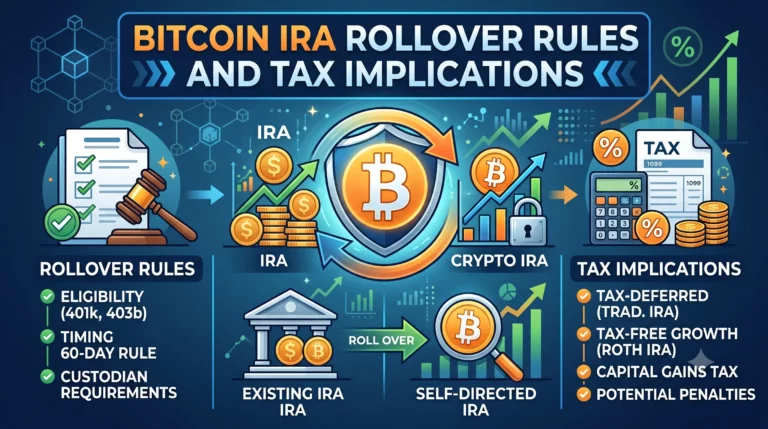
Introduction: Why the Bitcoin IRA Rollover Matters Now
Bitcoin IRA rollover strategies have moved from the margins of financial planning to the mainstream conversation — and for good reason. As cryptocurrency matures as an asset class, more retirement savers are exploring ways to gain tax-advantaged exposure to digital assets without sacrificing the protections their existing retirement accounts already provide. However, navigating the IRS rules that govern a Bitcoin IRA rollover is far from simple, and mistakes can trigger immediate taxes, early withdrawal penalties, and even IRS audits.
This guide is designed for investors at every level of familiarity with crypto — from the seasoned retirement planner considering portfolio diversification to someone who has just learned that rolling a 401(k) into a self-directed IRA holding Bitcoin is even possible. Understanding the mechanics, compliance requirements, and tax implications before you act is not optional; it is essential.
What follows is a comprehensive, fact-based breakdown of how a Bitcoin IRA rollover works, what the IRS says about it, where the risks lie, and how to execute the process without falling into costly traps.
Key Takeaways
- A Bitcoin IRA rollover allows investors to move funds from a traditional 401(k) or IRA into a self-directed IRA (SDIRA) that holds cryptocurrency, all without triggering an immediate taxable event — if executed correctly.
- The IRS treats Bitcoin and other cryptocurrencies as property, not currency. This classification has significant implications for how gains, losses, and distributions are taxed inside a retirement account.
- Rolling over funds within the 60-day window and ensuring the SDIRA uses an IRS-compliant digital asset custodian are the two most critical compliance steps to avoid early withdrawal penalties.
- Traditional crypto IRAs offer tax-deferred growth; Roth crypto IRAs offer tax-free growth. Choosing the right structure depends on your current income, expected future tax bracket, and investment horizon.
- Working with a qualified tax professional or financial advisor experienced in self-directed IRAs and cryptocurrency is strongly recommended before initiating any rollover.
What Is a Bitcoin IRA Rollover? Definition and Scope
A Bitcoin IRA rollover refers to the process of transferring funds from an existing qualified retirement account — most commonly a traditional IRA or employer-sponsored 401(k) plan — into a self-directed crypto IRA (SDIRA) that is authorized to hold alternative assets, including Bitcoin and other digital currencies.
Standard IRAs and 401(k) plans are limited by their custodians to conventional assets: publicly traded stocks, bonds, mutual funds, and ETFs. A self-directed IRA, by contrast, grants the account holder the ability to invest in a much broader range of assets, including real estate, private equity, precious metals, and — critically for our purposes — cryptocurrencies.
The term ‘rollover’ specifically describes the movement of funds from one retirement account type to another. Under the Internal Revenue Code, this movement can be executed as either a direct rollover (funds move directly between custodians, the investor never touches the money) or an indirect rollover (funds are distributed to the investor, who then has 60 days to deposit them into the new account). Only one indirect rollover is permitted per 12-month period across all IRAs an individual owns.
How a Bitcoin IRA Rollover Works: Step-by-Step Process
Step 1 — Choose a Compliant Self-Directed IRA Custodian
Not every financial institution can serve as a digital asset custodian for a self-directed crypto IRA. The IRS requires that all IRA assets be held by an approved trustee or custodian — this cannot be the investor themselves. Custodians specializing in crypto IRAs must comply with IRS Publication 590-A and the Employee Retirement Income Security Act (ERISA) where applicable.
When evaluating custodians, look for: regulatory track record, insurance coverage on digital holdings, cold storage security practices, fee transparency, and whether they support the specific cryptocurrencies you wish to hold.
Step 2 — Open Your Self-Directed IRA
Once you select a custodian, open the SDIRA account. This involves completing standard account documentation, identity verification under Know Your Customer (KYC) rules, and designating beneficiaries. At this stage you will also choose the IRA type — Traditional or Roth — which has significant downstream tax consequences discussed in detail below.
Step 3 — Initiate the Rollover
Contact your current plan administrator and request a rollover. For a 401(k) to crypto rollover, your employer’s plan administrator will process the distribution. Always request a direct rollover whenever possible. In a direct rollover, the check is made payable to the new custodian for the benefit of your account (not to you personally), which bypasses mandatory 20% withholding that applies to indirect 401(k) rollovers.
Step 4 — Fund the SDIRA and Purchase Bitcoin
Once funds arrive at the new SDIRA custodian, you direct the custodian to purchase Bitcoin (or other approved digital assets) on your behalf. Because the IRS prohibits self-dealing in IRAs, you cannot directly transfer Bitcoin you already own into an IRA — you must purchase it with cash inside the account.
Step 5 — Maintain Ongoing Compliance
Crypto held inside an IRA must be valued at fair market value for IRS Form 5498 reporting each year. Your custodian handles this reporting, but you remain responsible for ensuring the account stays in compliance with prohibited transaction rules under IRC Section 4975.
IRS Rules for Cryptocurrency in Retirement Accounts
The IRS has never issued guidance specifically addressing Bitcoin IRAs, but several foundational rulings govern how IRS rules for cryptocurrency apply within retirement accounts:
- IRS Notice 2014-21: Establishes that virtual currency is treated as property for federal tax purposes. This means Bitcoin held in a taxable account is subject to capital gains tax on disposal. Inside a retirement account, however, the standard IRA deferral and exemption rules apply instead.
- IRC Section 408: Governs traditional IRA structures and sets out what constitutes a prohibited investment or transaction.
- IRC Section 4975: Prohibits certain transactions between an IRA and ‘disqualified persons,’ including the account holder, their lineal descendants, and entities they control. Violating this rule can result in the entire IRA being treated as distributed — an extremely costly outcome.
- 60-Day Rollover Rule: If you take an indirect rollover, IRS regulations require that you redeposit the full amount into the new account within 60 days. Missing this deadline converts the distribution into taxable income, plus a 10% early withdrawal penalty if you are under age 59½.
- One-Rollover-Per-Year Rule: Since 2015, the IRS has enforced a strict rule: only one IRA-to-IRA indirect rollover is permitted per 12-month period across all IRAs owned by an individual (Bobrow v. Commissioner, T.C. Memo 2014-21). Direct trustee-to-trustee transfers are not subject to this limit.
Traditional vs. Roth Crypto IRA: Tax Implications Compared
Choosing between a traditional vs. Roth crypto IRA is one of the most consequential decisions you will make when structuring a Bitcoin IRA rollover. The tax treatment differs fundamentally:
| Feature | Traditional Crypto IRA | Roth Crypto IRA |
| Contributions | Pre-tax (deductible if eligible) | After-tax (non-deductible) |
| Growth | Tax-deferred | Tax-free |
| Withdrawals | Taxed as ordinary income | Tax-free if qualified |
| RMDs Required? | Yes — starting at age 73 | No RMDs during owner’s lifetime |
| Best For | Investors in a higher tax bracket today who expect a lower bracket in retirement | Investors who expect to be in a higher tax bracket at withdrawal, or who want tax-free compounding on potential BTC appreciation |
| Rollover Source | Traditional 401(k), traditional IRA — no conversion tax owed | Roth 401(k) direct; rolling traditional funds triggers a Roth conversion taxable event |
A Roth conversion — moving pre-tax retirement dollars into a Roth IRA — can be a powerful long-term strategy if you believe Bitcoin’s value will grow substantially, since all future appreciation would be withdrawn tax-free. However, the conversion amount is added to your taxable income in the year of conversion, which can create a significant tax bill depending on the size of the rollover.
Crypto Retirement Tax Benefits: What Investors Stand to Gain
The primary crypto retirement tax benefits stem from the same structural advantages that make any IRA attractive — with an additional layer of potential upside given Bitcoin’s historical price volatility:
- Tax-Deferred Compounding (Traditional IRA): Any Bitcoin held inside a traditional SDIRA grows without triggering annual capital gains events. If BTC were held in a taxable brokerage account, every sale or exchange would constitute a taxable event. Inside the IRA, you can rebalance or trade without immediate tax consequence.
- Tax-Free Growth Potential (Roth IRA): A Roth SDIRA holding Bitcoin offers the prospect of entirely tax-free appreciation. If an investor rolled $50,000 into a Roth Bitcoin IRA and that balance grew to $500,000 over 20 years, qualified withdrawals after age 59½ would be entirely free of federal income tax.
- Estate Planning Advantages: Roth IRAs pass to heirs without income tax on distributions (though estate tax rules may still apply). This makes a Roth Bitcoin IRA an appealing vehicle for long-term generational wealth transfer.
- Crypto Tax-Loss Harvesting Considerations: In a taxable account, crypto tax-loss harvesting allows investors to sell depreciated Bitcoin at a loss to offset gains elsewhere. Inside an IRA, this strategy is not available — losses inside a retirement account do not generate deductible tax losses. This is an important tradeoff to understand.
Risks and Pitfalls: A Balanced Assessment
Because this is a YMYL (Your Money or Your Life) topic, a rigorous examination of the risks is as important as any discussion of potential benefits. The following risks are well-documented and should be carefully weighed:
Market Volatility
Bitcoin is among the most volatile major asset classes in the world. The same price swings that can multiply an account balance can also erode it dramatically. Unlike the stock market, cryptocurrency markets operate 24/7, have limited regulatory circuit-breakers, and have experienced drawdowns exceeding 70–80% in prior bear cycles. Holding a highly volatile, non-diversified asset inside a retirement account — where liquidity is already restricted — amplifies these risks.
Custodian and Platform Risk
Not all digital asset custodians are equally secure or financially stable. The collapse of several prominent crypto firms in 2022 demonstrated that counterparty risk is real and consequential. Always verify that your chosen custodian holds client assets in segregated accounts, carries appropriate insurance (e.g., through Lloyd’s or Coincover), and has a clear regulatory standing.
Prohibited Transaction Risk
Violating the IRS’s prohibited transaction rules is potentially catastrophic. If the IRS determines that a prohibited transaction occurred, it may treat the entire IRA as distributed in the year the transaction occurred, resulting in full income tax liability on the account value plus a 10% early withdrawal penalty for investors under 59½. Common pitfalls include: using IRA-held crypto as personal collateral, transacting with a disqualified person, or personally taking custody of the crypto (even briefly).
Regulatory Uncertainty
The regulatory landscape for cryptocurrency continues to evolve. Future IRS guidance, SEC actions, or Congressional legislation could alter the treatment of digital assets in retirement accounts. While no specific changes are guaranteed, investors should factor regulatory risk into their long-term planning.
Fee Structures
SDIRA custodians that specialize in cryptocurrency often charge higher fees than conventional brokerages: setup fees, annual maintenance fees, transaction fees, and sometimes a percentage of assets under management. Over a long time horizon, elevated fees can meaningfully erode net returns.
Illustrative Scenario: A Bitcoin IRA Rollover in Practice
Hypothetical Example: Consider a 45-year-old investor named Marcus who has accumulated $120,000 in a traditional 401(k) with a former employer. Marcus has been investing in Bitcoin in a taxable brokerage account for several years and is familiar with the asset’s volatility. He believes Bitcoin’s long-term outlook merits a position in his retirement portfolio.
Marcus decides to roll $40,000 — roughly one-third of his 401(k) balance — into a self-directed IRA to purchase Bitcoin, while leaving the remaining $80,000 in a conventional IRA invested in index funds. He contacts his 401(k) plan administrator and requests a direct rollover to an IRS-approved digital asset custodian.
Because Marcus initiates a direct rollover, no withholding is required, no 60-day clock begins, and no taxable event occurs at the time of transfer. The SDIRA custodian opens his account, and Marcus directs the purchase of Bitcoin at the current market price. All future gains and losses occur within the IRA’s tax-deferred umbrella.
At age 73, Marcus begins taking required minimum distributions (RMDs) from his traditional Bitcoin IRA. The distributions are taxed as ordinary income based on the fair market value of the Bitcoin distributed. If instead Marcus had chosen a Roth conversion at the time of the rollover (paying income tax on the $40,000 in the year of conversion), all future qualified withdrawals would have been tax-free — a potentially more valuable outcome if Bitcoin appreciated significantly.
Note: This is a purely illustrative hypothetical designed to clarify mechanics. It does not represent investment advice or predict future returns.
Bitcoin IRA Rollover vs. Alternatives: Key Comparisons
For investors evaluating multiple pathways to crypto retirement exposure, the following comparison captures the key distinctions between a Bitcoin IRA rollover and its closest alternatives:
| Factor | Bitcoin IRA Rollover | Bitcoin ETF in Regular IRA | Taxable Crypto Brokerage |
| Direct BTC Ownership | ✓ Yes | ✗ No (fund exposure only) | ✓ Yes |
| Tax Treatment | Tax-deferred or tax-free (IRA rules) | Tax-deferred or tax-free (IRA rules) | Capital gains tax on each disposal |
| Custodian Complexity | High — specialized SDIRA custodian required | Low — standard IRA custodian suffices | Low — standard crypto exchange |
| Annual Contribution Limits | $7,000 (2024); $8,000 if age 50+ | $7,000 (2024); $8,000 if age 50+ | None (unlimited investment) |
| Typical Fees | Setup + annual + transaction fees (often 1–2%+ of AUM) | ETF expense ratio (~0.2–1%); standard IRA fees | Exchange trading fees; no annual fees typically |
| Liquidity | Restricted; early withdrawals penalized | Restricted; early withdrawals penalized | Full; no early withdrawal restrictions |
Avoiding Early Withdrawal Penalties: What You Must Know
The most financially damaging mistake a Bitcoin IRA investor can make is triggering an early withdrawal penalty. Under current IRS rules, distributions taken from a traditional IRA before age 59½ are subject to:
- Ordinary income tax on the full distribution amount
- An additional 10% early withdrawal penalty
For a crypto IRA where Bitcoin has appreciated significantly, this combination can result in an effective tax rate of 30–40% or more on the distributed amount, wiping out a substantial portion of investment gains.
Common triggers for unintended early distributions include:
- Taking custody of IRA-held Bitcoin personally (even temporarily) — this can constitute a ‘deemed distribution’
- Initiating an indirect rollover and failing to redeposit within 60 days
- Exceeding the one-rollover-per-year limit on indirect IRA rollovers
- Engaging in a prohibited transaction that causes the IRA to lose its tax-favored status
Exceptions to the 10% penalty exist for certain circumstances — including first-time home purchases, qualified higher education expenses, and substantially equal periodic payments (SEPP/72(t) distributions) — but these apply narrowly and must be carefully structured with professional guidance.
Frequently Asked Questions About Bitcoin IRA Rollovers
Q: Can I roll over a 401(k) to a Bitcoin IRA without paying taxes?
A: Yes — if you execute a direct rollover from a traditional 401(k) to a traditional self-directed IRA, no tax is owed at the time of the transfer. Tax is deferred until you take distributions in retirement. If you roll over into a Roth IRA, the amount converted is treated as taxable income in the year of conversion.
Q: Is it legal to hold Bitcoin in an IRA?
A: Yes. The IRS has not prohibited Bitcoin or other cryptocurrencies from being held in a self-directed IRA. However, the IRA must use an IRS-approved custodian, the assets must be held by the custodian (not the investor personally), and all prohibited transaction rules under IRC Section 4975 must be observed.
Q: What is the difference between a direct and indirect Bitcoin IRA rollover?
A: A direct rollover involves funds moving directly from the old plan custodian to the new SDIRA custodian — the investor never receives the funds. An indirect rollover involves the investor receiving the distribution and then redepositing it within 60 days. Direct rollovers are generally preferable: they avoid mandatory 20% withholding on 401(k) distributions and eliminate the risk of missing the 60-day deadline.
Q: Are there contribution limits for a Bitcoin IRA?
A: Standard IRA contribution limits apply: $7,000 per year for 2024 ($8,000 if you are age 50 or older). However, a rollover from an existing retirement account — as distinct from a new annual contribution — does not count against these annual contribution limits. There is no cap on the amount that can be rolled over.
Q: How is Bitcoin valued inside an IRA for tax reporting?
A: The IRS requires that IRA assets be reported at fair market value each year on Form 5498. For Bitcoin, this is typically the closing market price on December 31 as reported by major exchanges. Your SDIRA custodian is responsible for this annual valuation and reporting.
Conclusion: Weighing the Bitcoin IRA Rollover Opportunity
A Bitcoin IRA rollover represents a legally available strategy for retirement investors who wish to gain tax-advantaged exposure to the largest and most established cryptocurrency. The structural benefits — tax deferral in a traditional SDIRA, tax-free growth in a Roth SDIRA — are real and, for the right investor profile, potentially meaningful over a long time horizon.
At the same time, the risks are substantial and specific. Bitcoin’s price volatility, the complexity of SDIRA custodian selection, the stringent IRS rules around prohibited transactions, and the fee structures of specialized crypto custodians all demand rigorous due diligence. The consequences of a compliance error — from a missed 60-day rollover window to a prohibited transaction — can be severe and largely irreversible.
For investors considering this route, the path forward involves thorough research, selection of an IRS-compliant and financially sound digital asset custodian, and — above all — consultation with qualified tax and financial professionals before moving any retirement funds.
We encourage you to explore related resources on this site, including our guides to self-directed IRA rules, cryptocurrency tax strategy, and retirement portfolio diversification — each designed to help you build a more complete picture before making any major financial decision.
Important Disclaimer
The information provided in this article is for educational and informational purposes only. It does not constitute financial, legal, or real estate advice. Always consult with a licensed professional, attorney, or certified financial advisor before making any major decisions based on this content.